Pump.fun2026-10-04 06:12:03Pump.fun tops Hyperliquid in 30-day protocol revenue with $55.5 millionPump.fun generated $55.5 million in revenue over the past 30 days, edging past Hyperliquid’s $54.34 million, according to data from DefiLlama cited by BlockBeats on Oct. 4. Under that ranking, Pump.fun trails only Tether and Circle, which posted $508 million and $208 million respectively over the same period. The figures place Pump.fun ahead of Hyperliquid on a 30-day revenue basis in the latest snapshot referenced by the report.50
Hyperliquid2026-10-04 03:43:01Hyperliquid books first $14.58 million in USDC reserve revenue under AQAv2Hyperliquid has recorded its first payment tied to USDC reserves under its AQAv2 mechanism, according to a post by Hyperdash co-founder Hans. On Oct. 3, the AQAv2 treasury wallet received $14.58 million for the platform’s USDC reserves held over the previous 30 days, with the proceeds set to flow into the assistance fund for HYPE purchases. Hans said the structure creates a new revenue stream beyond trading fees, allowing the platform to earn from margin deposits themselves whether or not the funds are actively used in trading. Under the setup, users bridge USDC to Hyperliquid, Circle mints the corresponding asset on HyperEVM, and the treasury balance is charged daily and settled every 30 days. Coinbase and Circle have each staked 500,000 HYPE, while a missed payment could cost Coinbase 2% of its staked amount per day. The first payment covered Aug. 26 to Sept. 24, implying an average rate of about 3.14% and annualized revenue of roughly $193 million at the current scale. Hans also said Hyperliquid’s open interest rose from $7.72 billion to $16.4 billion between Jan. 1 and Sept. 30, while platform margin increased from $4.34 billion to $7.22 billion.50
Ostium2026-10-03 14:46:11Ostium co-founder details protocol finances, says two-year on-chain revenue reached about $44.7 millionOstium co-founder Kaledora has outlined the real-world asset perpetuals protocol’s revenue model, saying Dune data shows roughly $44.7 million in total on-chain revenue over two years. She said the figure came from four fee categories: $20.39 million in opening fees, $16.5 million in spreads, $4.75 million in rollover fees, and $3.35 million in liquidation fees. Of that amount, $22.14 million, or 49.6%, went to the OLP treasury, while $19.55 million, or 43.8%, was attributed to liquidity costs, including $16.05 million in hedging and $3.49 million in hedge financing interest. Gross profit retained was $2.96 million, or 6.6%. Kaledora added that total on-chain revenue does not include off-chain hedging costs. She said the protocol had not yet been able to monetize traffic before its April liquidity upgrade, and that a security incident occurred after the upgraded system had been running for several months. She also listed Ostium’s fundraising history from 2022 through 2025, described team growth from about 12 people in 2025 to 35 by the second quarter of 2026, and said the next step is to let the remaining 345 OLP holders share in business growth, with a phase-two recovery plan due within the next week.20
Synthra Finan2026-10-02 15:17:41Synthra Finance says it bought back and burned nearly 2 million POLLSynthra Finance said in a post on X that it directly repurchased nearly 2 million POLL from the market and has already burned the tokens. The project said the latest buyback was funded by protocol revenue and described the move as another round of buyback and burn activity. After the transaction, Synthra Finance said the cumulative amount burned is now close to 7% of POLL’s total supply. The update was reported by ChainCatcher.20
token buyback2026-10-02 10:40:0815 crypto apps compared by buybacks and token payoutsA growing number of crypto projects are tying protocol income more directly to token value capture, but the mechanics vary sharply even when teams use the same labels. MarsBit reviewed 15 projects and compared how they generate income, what share of fees or revenue goes to buybacks, whether purchased tokens are burned, and whether holders receive any direct distribution. The list includes Hyperliquid, Pump.fun, Uniswap, Sky, Aave, Jupiter, Ethena, Morpho, Pons, PancakeSwap, Pendle, Raydium, ether.fi and Aster. Some models send nearly all designated fees into automated buybacks and permanent burns. Others route purchased tokens into treasury reserves or long-term lockups. In several cases, token holders only benefit indirectly, while stakers under separate programs receive the actual distribution. The article also draws a line between fees and revenue. High fee volume does not mean a protocol keeps the same amount after LP payouts, creator shares, rebates, market-maker arrangements or frontend incentives. It also argues that buyback headlines alone are not enough: investors still need to check whether the mechanism is automatic or discretionary, and whether token emissions and unlocks outweigh the amount being repurchased.40
Uniswap2026-10-02 01:27:35Token Terminal says Uniswap deployment on Robinhood Chain made up 53% of September revenueUniswap’s deployment on Robinhood Chain has quickly become the protocol’s largest source of revenue, according to data cited by BlockBeats from Token Terminal on Oct. 2. The figures show that this deployment accounted for 53% of Uniswap’s total revenue in September, which came in at $14.7 million. The update points to Robinhood Chain as the biggest contributor to Uniswap’s revenue mix for the month, based on the data referenced in the report.20
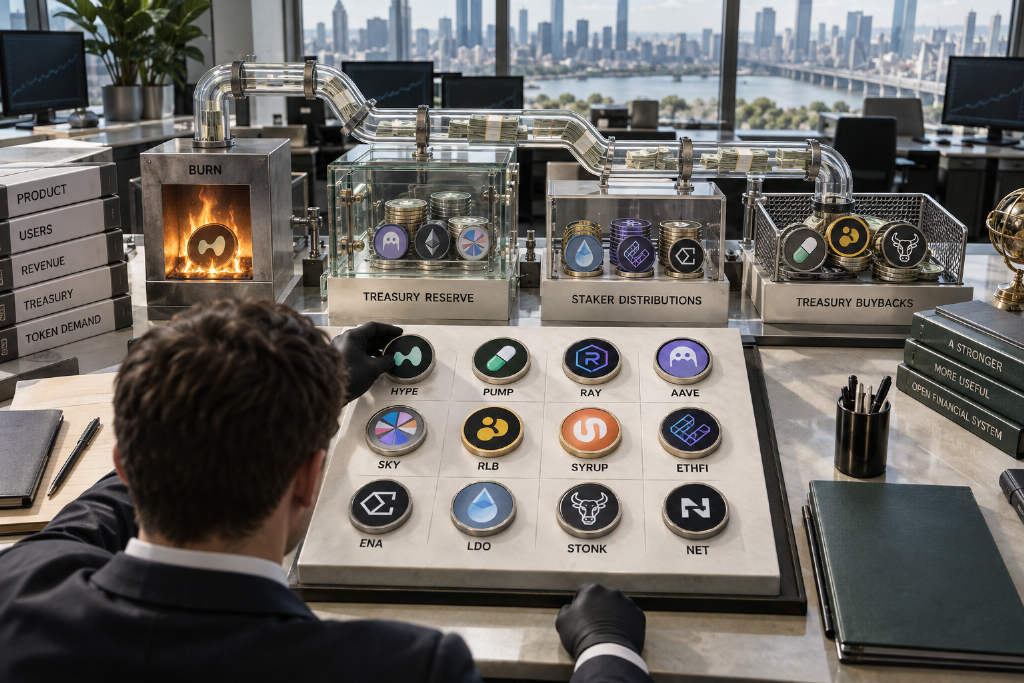
Policy Regula2026-09-29 02:45:0012 crypto tokens to watch as buybacks tie protocol revenue to token demandA PANews article translated by Jinse Finance maps out 12 crypto tokens with buyback mechanics and argues that the market should focus less on headlines about repurchases and more on whether protocol revenue actually creates token demand. The list includes HYPE, PUMP, RAY, AAVE, SKY, RLB, SYRUP, ETHFI, ENA, LDO, STONK and NET, with each project using a different structure to route value from business activity back to its token. Some models center on open-market purchases followed by token removal from circulation, as in Hyperliquid’s HYPE and parts of the cases for PUMP, RAY, RLB and STONK. Others work differently. Aave channels bought-back AAVE into its Ecosystem Reserve. EtherFi uses revenue to buy ETHFI and distribute most of it to sETHFI holders. Ethena has discussed a framework that could direct up to 95% of net protocol revenue to ENA buybacks once USDe reaches certain milestones. NetNet Capital ties its repurchase logic to net asset value, buying below NAV and potentially issuing above certain NAV multiples. The author’s core test is simple: where does the money actually go? The article says investors should watch annual buyback value relative to market capitalization, how many purchased tokens truly leave circulation, and whether revenue growth is being offset by emissions, unlocks or later selling pressure.300
Hyperliquid2026-09-28 09:30:07Hyperliquid posts $1.11 million in priority fee revenue this weekHyperliquid generated $1.11 million in priority fee revenue this week, according to BlockBeats. Measured on its own as if it were a standalone protocol, that revenue would rank 36th across the network, just behind Dexscreener and Lighter. The priority fee refers to an extra tip paid by traders who want their orders packaged faster and executed ahead of others. It is typically used when the network is congested or when traders are trying to get ahead in fast-moving transactions. The figure highlights how much users are willing to pay for execution speed on Hyperliquid during active trading periods.230